
Separation of Ownership and Usage
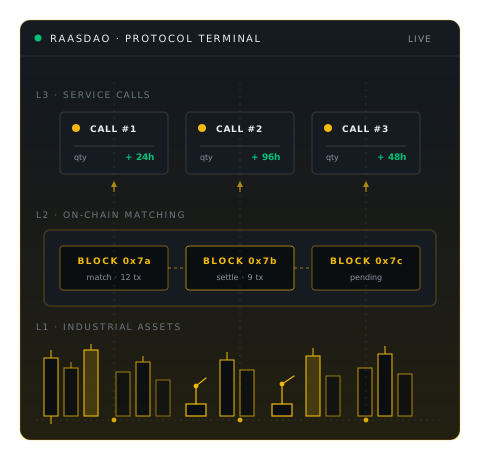
Like cloud servers for compute, turn industrial robots from heavy assets into on-demand, subscription-based productivity services. Holders keep ownership; users pay only for actual capacity consumed.


Robotic Assets, As Fluid As Compute
Industrial robots demand large upfront capital and long payback cycles; most mid-sized makers cannot absorb the CapEx.
Off-peak hours lack any shared channel — idle productivity never converts into tradable value.
Devices on different brands and bus protocols stay isolated, blocking joint scheduling across factories.
Centralized platforms keep operating data and matching rules opaque, structurally weakening asset-holder bargaining power.
Decouple hardware ownership from on-demand usage, turning robots from heavy assets into subscription-grade productivity.
One unified interface protocol connects devices across factories, brands, and regions into a single scheduling network.
Smart-contract auto-matching, on-chain settlement, and DAO governance replace platform arbitration with public rules.
Like cloud servers for compute, turn industrial robots from heavy assets into on-demand, subscription-based productivity services. Holders keep ownership; users pay only for actual capacity consumed.

A unified interface protocol connects devices across factories, brands, and regions into one scheduling network.

Holders earn yield, users cut CapEx, smart contracts auto-match and settle.
Let idle capacity keep earning.
Call capacity on demand, no purchase.
DAO governance, no vendor lock-in.
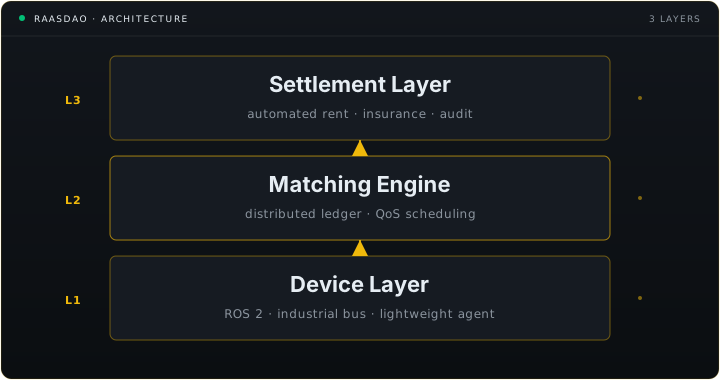
Single-factory pilots; lightweight agents over ROS 2 and major industrial buses.
Regional production networks; multi-vendor co-scheduling.
Protocol-level interoperability; capacity flows brand-agnostically.
Matching kernel and settlement primitives validated on test network.
Multi-sig custody, QoS validation, transparent yield allocation.
Mainnet launch; parameters and treasury governed by the DAO.
Phase order is fixed; concrete dates announced as measured progress permits.
Connect to the protocol and turn your robotic assets into on-call productivity services.